
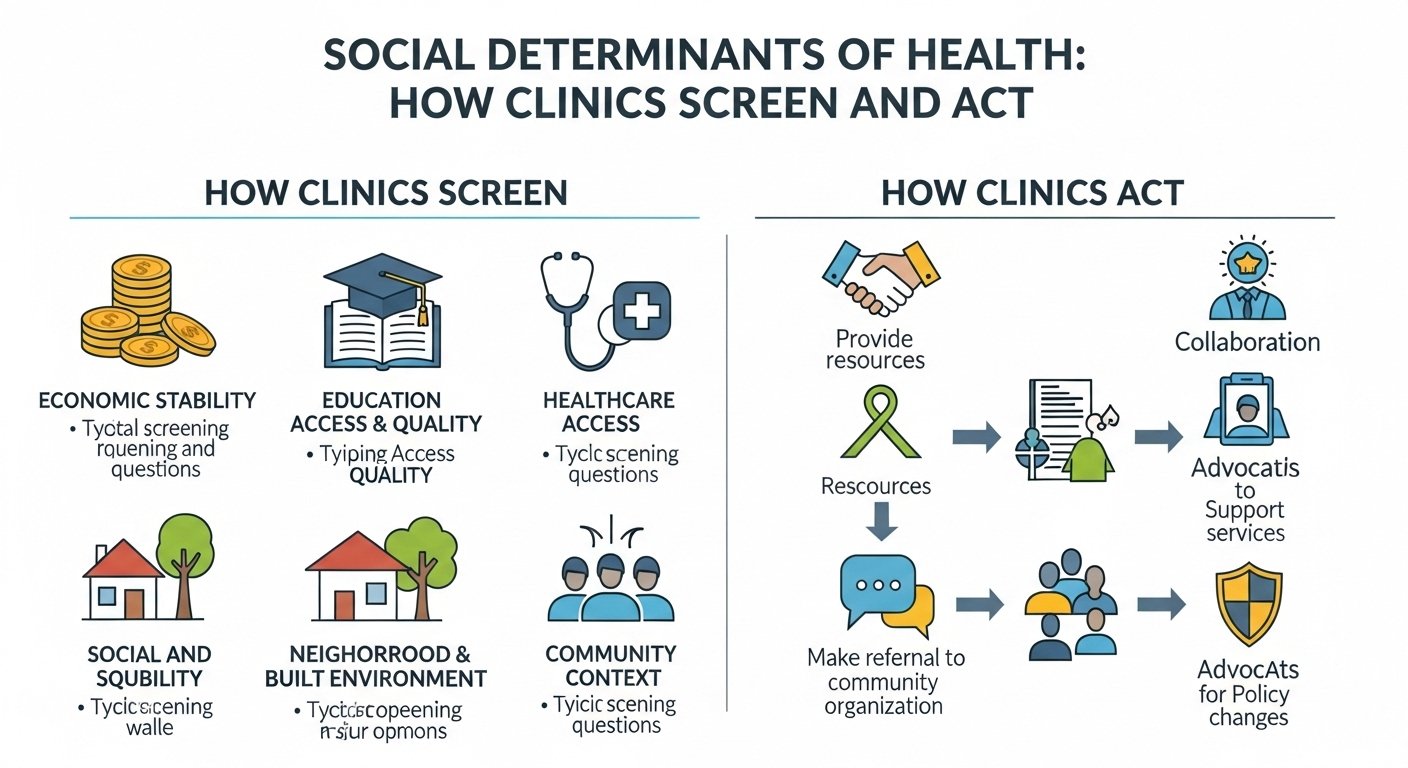

Social determinants of health (SDOH) — the non-medical conditions in which people are born, live, learn, work, and age — account for up to 80% of health outcomes. These include economic stability, housing quality, educational attainment, social connections, neighborhood environment, and access to food and healthcare. Medical clinics increasingly screen for social risk factors and connect patients with community resources, recognizing that clinical care without addressing the social conditions driving illness produces incomplete and often ineffective results. This guide explains SDOH screening and response at the clinic level.
Core Social Risk Factors
- Food insecurity (see Article 216)
- Housing instability — inability to pay rent, unsafe housing, homelessness
- Transportation barriers — inability to get to clinic appointments or pharmacy
- Utility insecurity — inability to pay for heating/cooling (affects medication storage)
- Social isolation — limited social support network
- Interpersonal violence — domestic violence, intimate partner violence
- Employment and income insecurity
- Educational barriers — low health literacy
Clinic SDOH Screening Tools
The PRAPARE (Protocol for Responding to and Assessing Patients’ Assets, Risks, and Experiences) assessment is the most widely used comprehensive SDOH screening tool in clinical settings — assessing multiple domains of social risk in a single structured questionnaire. The Accountable Health Communities (AHC) Health-Related Social Needs screening tool and the PREPARE assessment are alternatives. These screens are administered by medical assistants, nurses, or through digital self-administered intake forms and flag social risks for clinical team response.
Responding to SDOH
Screening without action is meaningless. Effective responses include: warm referrals to community health workers who help patients navigate social service systems; connection to community resource databases (211 social services hotline, findhelp.org, NeedyMeds.org); in-clinic social workers who assess needs and connect patients with local resources; and advocacy for systemic policy changes that address root causes of social inequity.
Conclusion
Medical clinics cannot fix poverty, housing instability, or food insecurity — but they can screen for these factors, connect patients with community resources, and provide care that acknowledges the social context of illness. SDOH-responsive clinical care treats the whole person and their circumstances, not just the biological manifestation of disease in a social vacuum.
FAQs – Social Determinants of Health
Q1. Why should doctors ask about my housing or finances?
A: Social conditions directly affect health outcomes — a patient with unstable housing cannot adequately rest and recover from illness; a patient who cannot afford medications cannot adhere to treatment; a patient experiencing domestic violence has fundamentally compromised health. Understanding these factors allows the clinical team to address barriers to care that purely biomedical approaches miss.
Q2. What happens with my SDOH information — is it kept confidential?
A: SDOH screening information is part of your medical record and subject to the same HIPAA protections as all health information. It is shared within your care team for care coordination purposes. It is not shared with employers, housing authorities, or other entities without your specific authorization.
Q3. What is a community health worker?
A: Community health workers (CHWs) are frontline healthcare workers who share the lived experience of the communities they serve and bridge between clinical settings and community resources. They provide social support, health education, care navigation, and connection to social services that clinicians often don’t have time to provide during brief clinical encounters.
Q4. Can I call 211 for social service help?
A: Yes. 211 is a nationwide social service hotline (in most US communities) providing referrals to local food banks, housing assistance, utility assistance, childcare, healthcare access, and many other social services. Available by phone and increasingly online (211.org).
Q5. Does addressing SDOH actually improve health outcomes?
A: Yes. Programs addressing food insecurity through produce prescriptions, housing instability through supportive housing, and social isolation through community connection all demonstrate measurable improvements in chronic disease management, emergency department utilization, and total healthcare costs. The evidence base for addressing SDOH as healthcare is growing.