
Medical cannabis — the use of cannabis or cannabinoid compounds for medical purposes — has been legalized in some form in most US states, creating a complex landscape for clinicians who simultaneously face patient demand, state laws permitting certification, and federal Schedule I classification that limits prescribing authority and research. Understanding what medical clinics can and cannot legally and ethically do regarding cannabis helps patients seeking medical guidance. This guide explains the clinical reality of medical cannabis at the provider level.
What Clinics Can Do
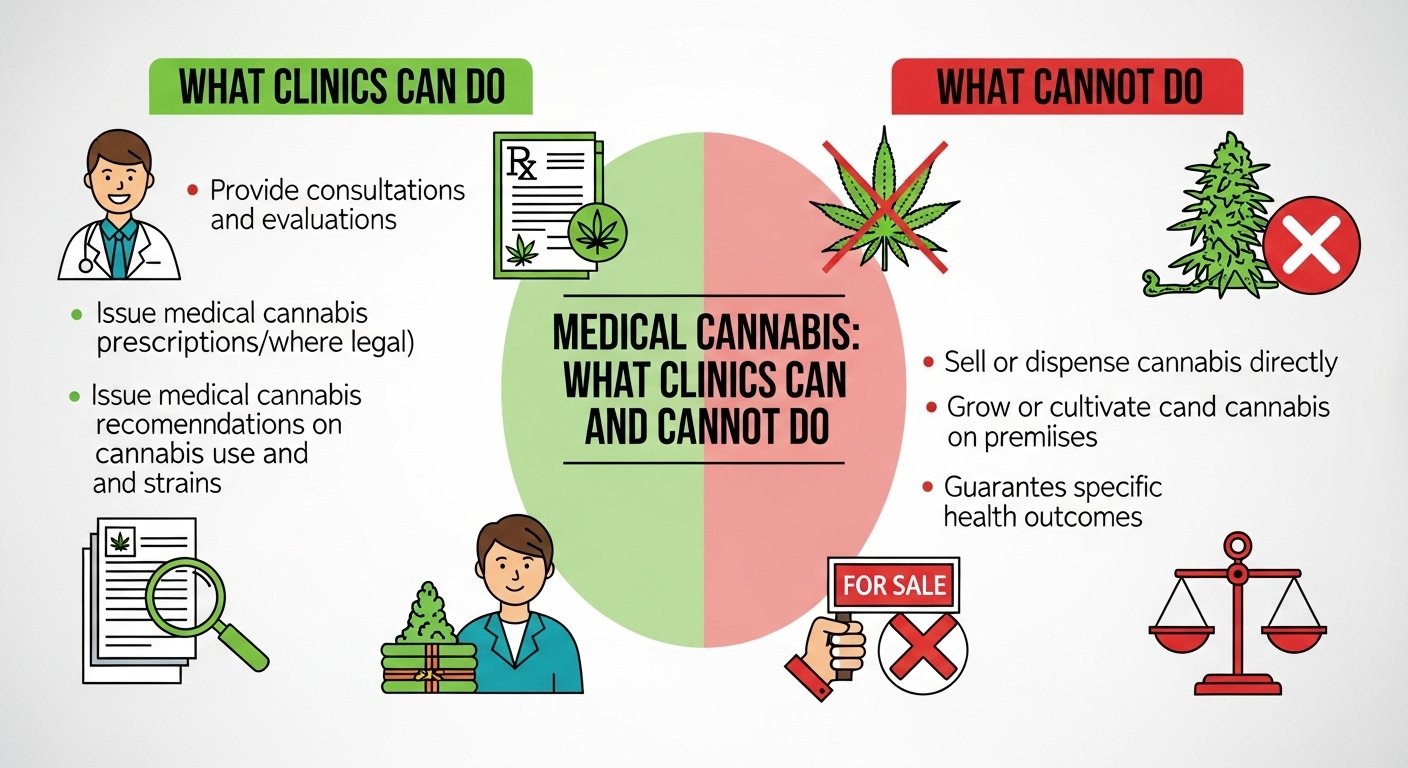
In states with medical cannabis programs, licensed physicians can certify patients as qualifying for medical cannabis use — certifying that the patient has a qualifying condition listed in the state’s program. This certification is not a prescription (cannabis remains Schedule I federally and cannot be prescribed through the standard DEA-licensed prescribing system) but rather a recommendation or certification of qualifying condition status. The cannabis product itself is then obtained through a state-licensed dispensary, not a pharmacy.
Conditions Where Cannabis Evidence Is Strongest
- Nausea from chemotherapy — significant evidence; FDA-approved cannabinoids (dronabinol, nabilone) exist
- Neuropathic pain — moderate evidence particularly for cannabis-based medical products
- Spasticity in multiple sclerosis — good evidence for oral cannabis extracts (Sativex, not US-approved)
- Specific pediatric epilepsy syndromes — FDA-approved CBD (Epidiolex) is a plant-derived pharmaceutical, not dispensary cannabis
What Clinics Cannot Do
Prescribe cannabis (federal law prohibits); recommend specific dispensary products (no federal standardization); guarantee consistency between products (cannabis products lack pharmaceutical-grade standardization); provide clinical guidance based on robust evidence for most conditions (evidence base is limited by research restrictions on Schedule I substances); or accept liability for clinical outcomes related to cannabis use that is not FDA-approved treatment.
Conclusion
Medical cannabis is a complex clinical area where state law, federal law, and evolving evidence all intersect. Clinicians can certify qualifying conditions in states with medical cannabis programs, discuss the evidence and risks, and help patients make informed decisions. For specific conditions with strong evidence (chemotherapy nausea, pediatric epilepsy), FDA-approved cannabinoid medications are available through standard prescribing. For other conditions, patients seeking cannabis should understand the current evidence limitations and regulatory landscape.
FAQs – Medical Cannabis
Q1. Is CBD the same as medical cannabis?
A: CBD (cannabidiol) is one of many cannabinoids in cannabis — it does not produce psychoactive effects. FDA-approved pharmaceutical CBD (Epidiolex) is a prescription medication for specific epilepsy conditions. Over-the-counter CBD products are food supplements, not medical treatments, and have limited regulatory oversight for purity and labeling accuracy.
Q2. Can smoking cannabis harm my lungs?
A: Yes. Regular cannabis smoking is associated with chronic bronchitis, respiratory symptoms, and potentially higher lung cancer risk (though evidence is less clear than for tobacco). Vaporization, oral administration, or sublingual tinctures are lower-risk delivery methods for medical purposes.
Q3. Will my doctor judge me for using cannabis?
A: Good clinicians provide non-judgmental medical care. Informing your doctor about cannabis use — including frequency, method, and products used — is important for safe medication management (cannabis interacts with many medications through CYP450 enzyme pathways) and complete clinical picture. Your doctor needs this information to provide safe care.
Q4. Can cannabis help with anxiety?
A: Cannabis effects on anxiety are complex and bidirectional. Low doses of CBD may reduce anxiety; THC can reduce anxiety at low doses but worsen it at higher doses, particularly in inexperienced users. Chronic heavy cannabis use is associated with increased anxiety and can trigger cannabis-use disorder. The evidence base for cannabis as an anxiety treatment is not strong enough to recommend it over proven treatments (SSRIs, CBT).
Q5. Can I drive after using medical cannabis?
A: Cannabis impairs driving — affecting reaction time, tracking, and judgment. Impaired driving under cannabis is illegal in all states regardless of medical use status. The safe driving interval after cannabis use is not well-established (unlike the 0.08 BAC legal limit for alcohol), but impairment can last 3–4 hours for inhaled cannabis and longer for oral forms.