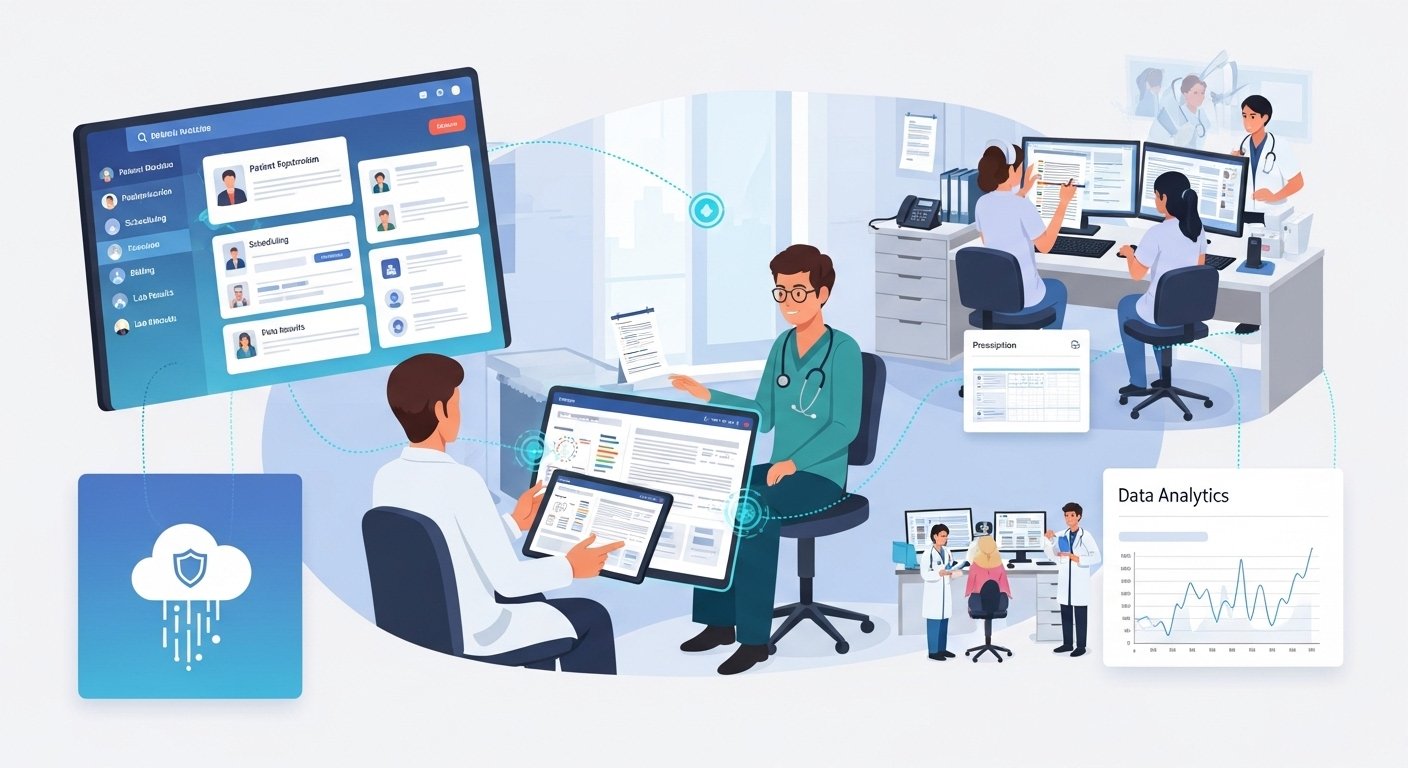

Electronic health records (EHRs) — digital systems that store and manage patient health information, replacing paper charts — are now ubiquitous in US healthcare, with over 90% of office-based physicians using EHR systems. They have transformed clinical documentation, enabled population health management, improved medication safety, and supported clinical decision-making — while also creating new challenges around documentation burden, workflow inefficiency, and clinician burnout. Understanding how EHRs work and how your clinic uses them helps you engage more effectively with digital health tools. This guide explains EHR function in the clinic setting.
Core EHR Functions
Clinical Documentation
Clinicians document every clinical encounter — SOAP notes (Subjective findings from history, Objective exam findings, Assessment of diagnoses, Plan for treatment) — in the EHR rather than paper charts. Documentation is accessible to all authorized care team members across the healthcare system in real time. The 21st Century Cures Act mandates that patients have timely access to their clinical notes through patient portals.
Order Entry and Medication Management
Computerized Physician Order Entry (CPOE) — all laboratory tests, imaging, medications, and referrals are ordered electronically. Clinical Decision Support (CDS) provides real-time alerts for drug interactions, allergy conflicts, dose range checks, and guideline-concordant care reminders. These automated safeguards catch potential errors that paper-based systems missed.
Care Coordination and Interoperability
EHRs facilitate information sharing between providers — discharge summaries, specialist notes, and laboratory results transmitted electronically within and increasingly across health systems. Health information exchanges (HIEs) and FHIR (Fast Healthcare Interoperability Resources) standards are expanding EHR interoperability, enabling more seamless information flow across different health systems.
EHR Challenges
Despite their benefits, EHRs contribute significantly to clinician burnout — physicians spend more time on EHR documentation than on direct patient care in many settings. “Alert fatigue” from excessive clinical decision support notifications reduces their effectiveness. EHR data quality depends on clinician documentation diligence. Interoperability remains incomplete — records don’t always follow patients across health systems.
Conclusion
EHRs are powerful tools that have improved certain aspects of safety and care coordination while creating new challenges for clinicians and workflow. The patient portal — your window into the EHR — gives you access to your records, test results, and care team communication in ways that paper charts never enabled. Engaging with your patient portal is the most direct way to benefit from your clinic’s EHR investment.
FAQs – Electronic Health Records
Q1. Can I see everything in my medical record?
A: The 21st Century Cures Act mandates timely patient access to all electronic health information including clinical notes, lab results, imaging reports, and most other record types. Some psychotherapy notes and information that could harm the patient or others may have limited access. Your patient portal is the primary access point for your electronic health information.
Q2. Why do doctors spend so much time looking at the computer during my visit?
A: EHR documentation requirements — which are tied to billing codes, quality measures, and legal documentation — create significant documentation burden during clinical encounters. Clinicians who document during visits are recording your clinical history, orders, and care plan in real time. “Scribes” (staff who handle EHR documentation, freeing the clinician to maintain eye contact) and AI-powered ambient documentation tools are reducing this burden.
Q3. Are my medical records safe in an EHR?
A: HIPAA requires robust security for electronic health records — encryption, access controls, audit logs, and breach notification requirements. Healthcare organizations are frequent targets of cyberattacks. Breaches occur despite security measures. Healthcare organizations are required to notify affected patients when their unsecured health information is breached.
Q4. What happens to my EHR if my clinic closes or changes systems?
A: Your health information should remain accessible to you regardless of clinic changes. Federal law requires that patients be provided access to their records. If your clinic closes or is acquired, ask specifically how to access your records — they should be transferable to your new provider. Keep copies of important health records in your own files as a personal safeguard.
Q5. Can different doctors see each other’s notes in the EHR?
A: Within the same health system using the same EHR, clinicians can typically access records from other providers treating the same patient. Across different health systems using different EHRs, information sharing requires interoperability connections, direct record requests, or patient-facilitated record transfer. Interoperability is improving but remains incomplete across all healthcare settings.