
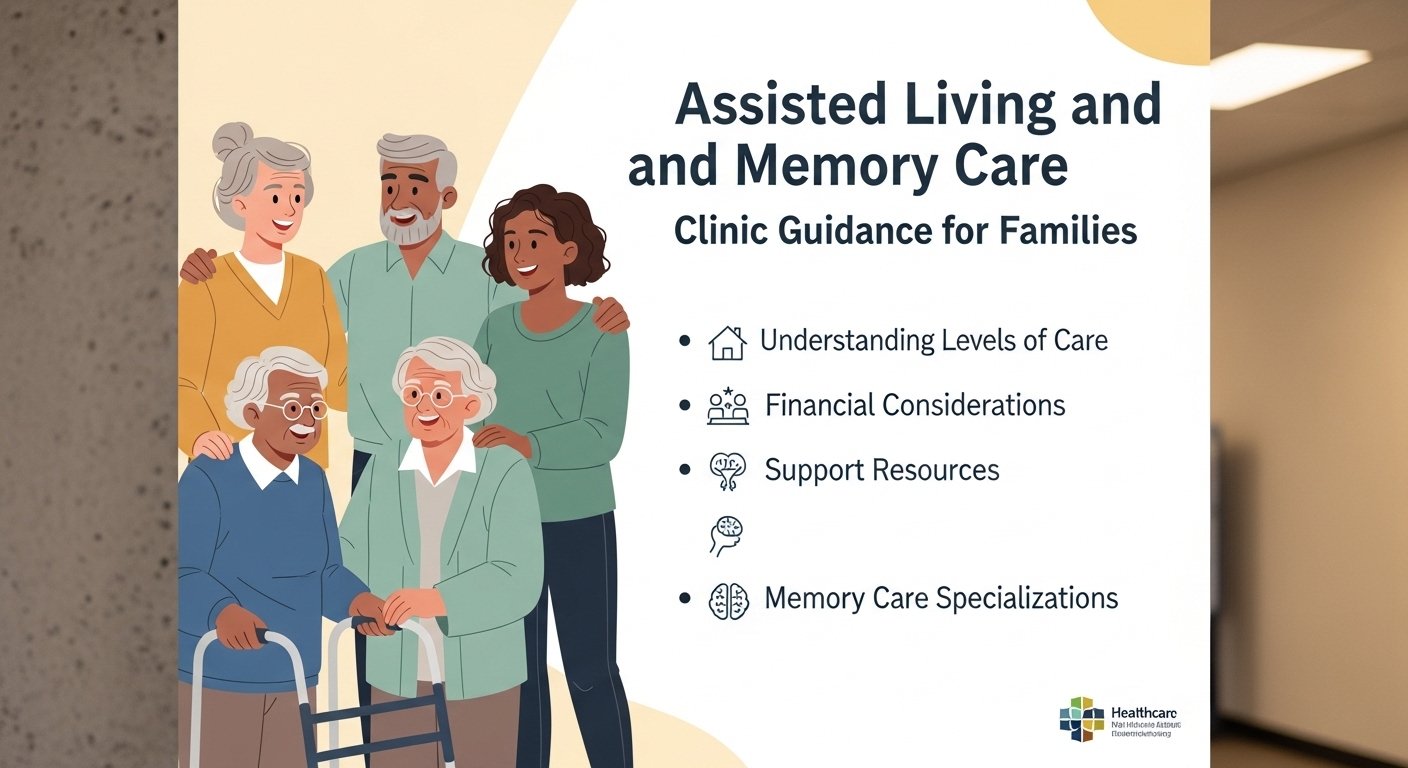

Assisted living facilities — residential communities providing personal care, meals, activities, and varying levels of healthcare support for older adults who need assistance with daily activities but do not require 24-hour skilled nursing care — and memory care units (specialized assisted living for people with dementia requiring secure environments and dementia-specialized care) represent important long-term care options that many families navigate with limited prior knowledge. Medical clinics play a role in recognizing when home-based care is no longer safe, recommending transitions, and supporting patients and families through these difficult decisions. This guide explains how clinics support families navigating assisted living and memory care choices.
When Assisted Living May Be Appropriate
Assisted living is typically considered when: a person needs assistance with multiple activities of daily living (bathing, dressing, medication management, meal preparation) that exceeds what family members can reasonably provide; a person is experiencing falls, medication errors, or other safety events at home; social isolation is worsening cognitive or physical health; or family caregiver burnout is reaching an unsustainable level. The clinic can provide formal documentation of the care level needed to support placement decisions.
Memory Care: When Dementia Requires Specialist Environment
Memory care units within assisted living communities (or standalone memory care facilities) provide: secure environments preventing wandering; staff specially trained in dementia care; structured daily programming that maintains cognitive engagement; and close monitoring for behavioral and medical changes common in dementia. Memory care is considered when dementia symptoms create safety risks — wandering, aggression, inability to perform self-care, or caregiver burnout — that exceed what standard assisted living or home care can safely manage.
Clinic’s Role in Long-Term Care Planning
Clinicians provide: assessment of functional status and care needs that informs placement decisions; documentation supporting assisted living or memory care admissions; medication reconciliation for facility staff; ongoing primary care coordination with facility nursing staff; advance care planning discussions that ensure the person’s care preferences are honored as disease progresses; and hospice referral when appropriate.
Conclusion
The decision to transition to assisted living or memory care is one of the most difficult families face — and one where clinical guidance can provide both practical support (functional assessment, documentation) and emotional support (validation of difficult decisions, prognosis information). Involve your clinic provider early in care transition planning — not only in crisis moments when urgency limits options.
FAQs – Assisted Living and Memory Care
Q1. Does Medicare cover assisted living?
A: Medicare does not cover room and board at assisted living. Medicare covers skilled care services (occupational therapy, physical therapy, skilled nursing) that may be provided at an assisted living facility for Medicare-eligible residents. Medicaid covers assisted living at a limited number of Medicaid-certified facilities for eligible low-income individuals through waiver programs that vary by state. Most assisted living is paid privately.
Q2. How do I know when my parent needs memory care instead of standard assisted living?
A: Signs memory care may be needed: wandering (leaving the facility or getting lost); behavioral symptoms (aggression, severe anxiety, sundowning) that standard assisted living cannot manage; inability to follow instructions from staff; significant safety risks from impaired judgment that a non-secure environment cannot mitigate. Your geriatrician or neurologist can provide a formal assessment.
Q3. How do I evaluate the quality of an assisted living facility?
A: Visit multiple times (announced and unannounced); speak with current residents and families; review state inspection reports; observe staff interactions; assess staff turnover rates (high turnover often indicates poor management); evaluate the physical environment (cleanliness, odor, safety); review the level of care agreement and specific services provided; and ask about what happens when care needs escalate beyond the facility’s capacity.
Q4. Can someone with dementia refuse to move to memory care?
A: This is an extremely common and difficult situation. A person with significant dementia may lack the decision-making capacity to make informed decisions about their living situation. In this case, the legal guardian or healthcare proxy makes the decision in the person’s best interest. Your clinic can provide a formal capacity assessment if needed to clarify the decision-making situation.
Q5. What is respite care?
A: Respite care provides temporary relief for family caregivers — short-term placement of their family member in an assisted living or skilled nursing facility (or use of in-home respite aides) to allow caregivers to rest, recover from illness, travel, or address other personal needs. Medicare provides limited respite care coverage under the hospice benefit; respite care outside hospice is primarily privately paid or through Medicaid waiver programs.